Research
Understand the model, develop your view, save reasoning, compare captured history and search across your models. Read Methods and develop drafts; IRIS does not execute them. Claude assists and Excel calculates.
An IRIS model is a company forecast in Excel, accompanied by its documented forecasting approach and a persistent record of the research and judgments you choose to save.
Choose a catalog model. Open it in Excel. Work with Claude. Save the work worth keeping.
Use your own Claude and Excel subscriptions.
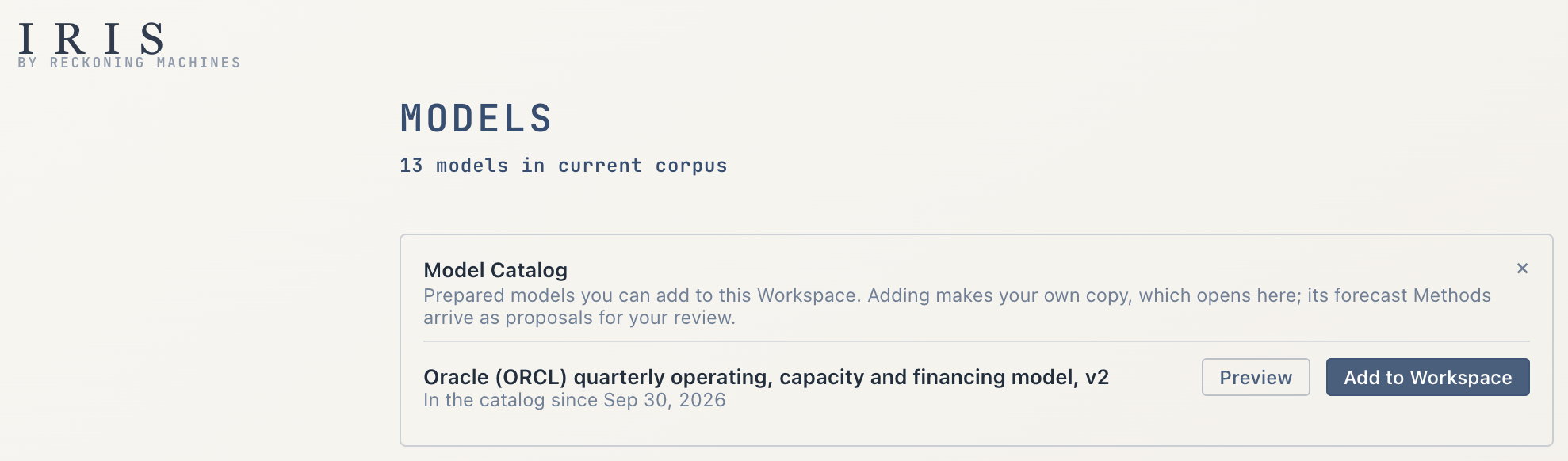
Explore prepared catalog models and review their coverage, checks and limitations.
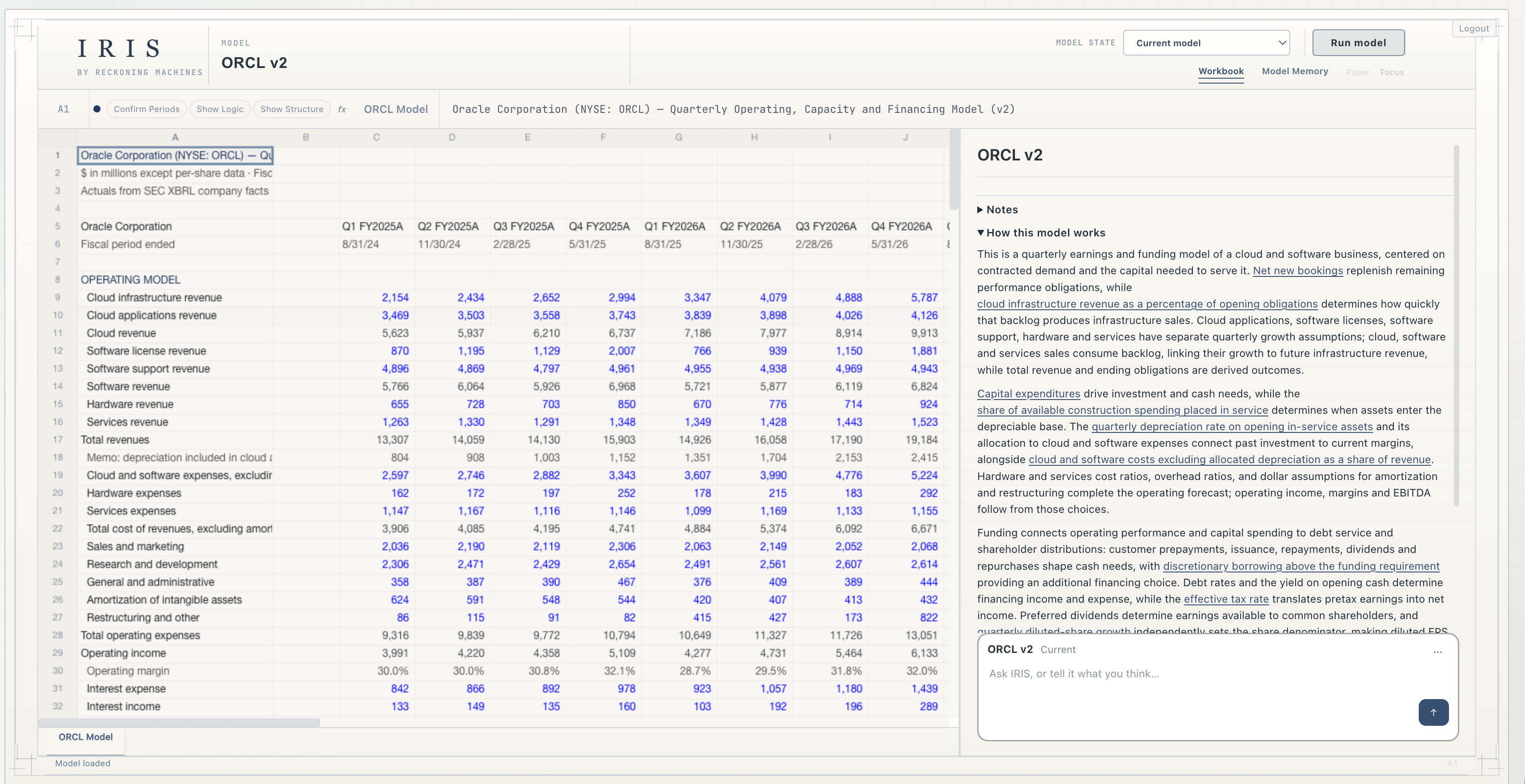
Add the model to your workspace and open its workbook in Excel.
Use Claude to understand the forecast, question assumptions and work through the evidence.
Save useful research, judgments and workbook captures to the model's record.
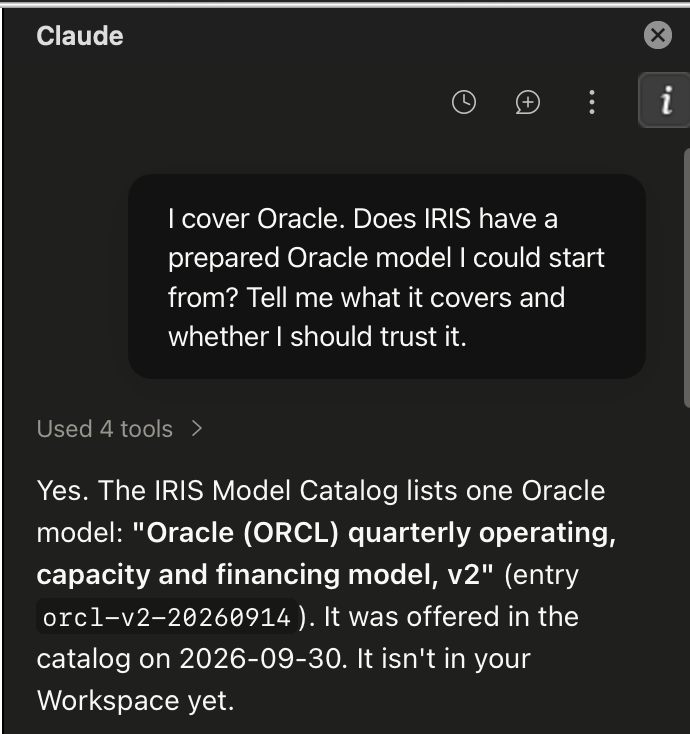
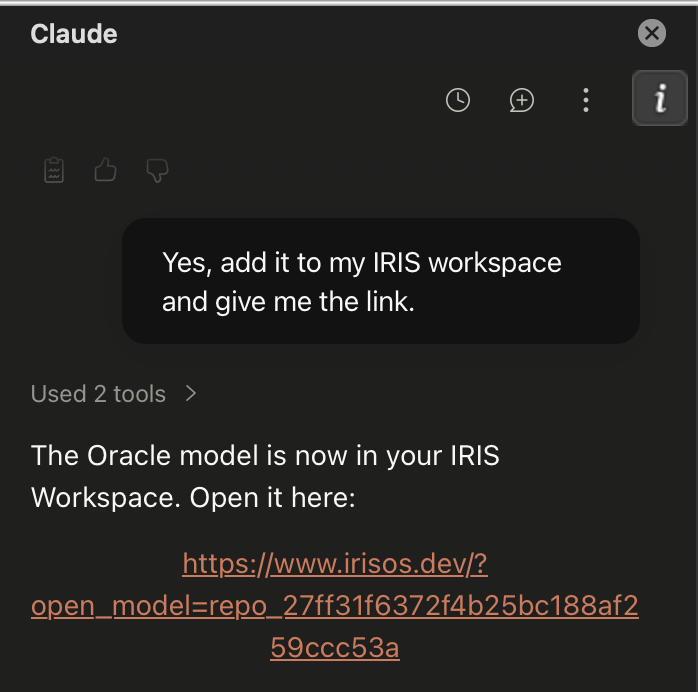
The same model and research record across upgrades.
Understand the model, develop your view, save reasoning, compare captured history and search across your models. Read Methods and develop drafts; IRIS does not execute them. Claude assists and Excel calculates.
Put your forecasting approach to work. Run approved Methods against new evidence, inspect the resulting estimates, and keep the inputs, reasoning and results together.
Know what could change your decision and what is worth finding out. Identify the uncertainties that matter, estimate the value of resolving them, and focus research where it could change your action.
Planned: probability-based forecasts and value-of-information analysis informed by Applied Information Economics.
Not currently available for purchase.
Forecast is currently offered with assisted setup; paid signup remains closed. Contact us for access or a research-team demo.
Each catalog model arrives with its structure and forecasting approach documented, so you can start by examining the business and its assumptions.
Alongside the workbook sits a persistent research record: the evidence, interpretations and judgments you choose to save. Develop your own view without losing the starting approach.
Start with the company. Keep the work that helps explain your forecast.
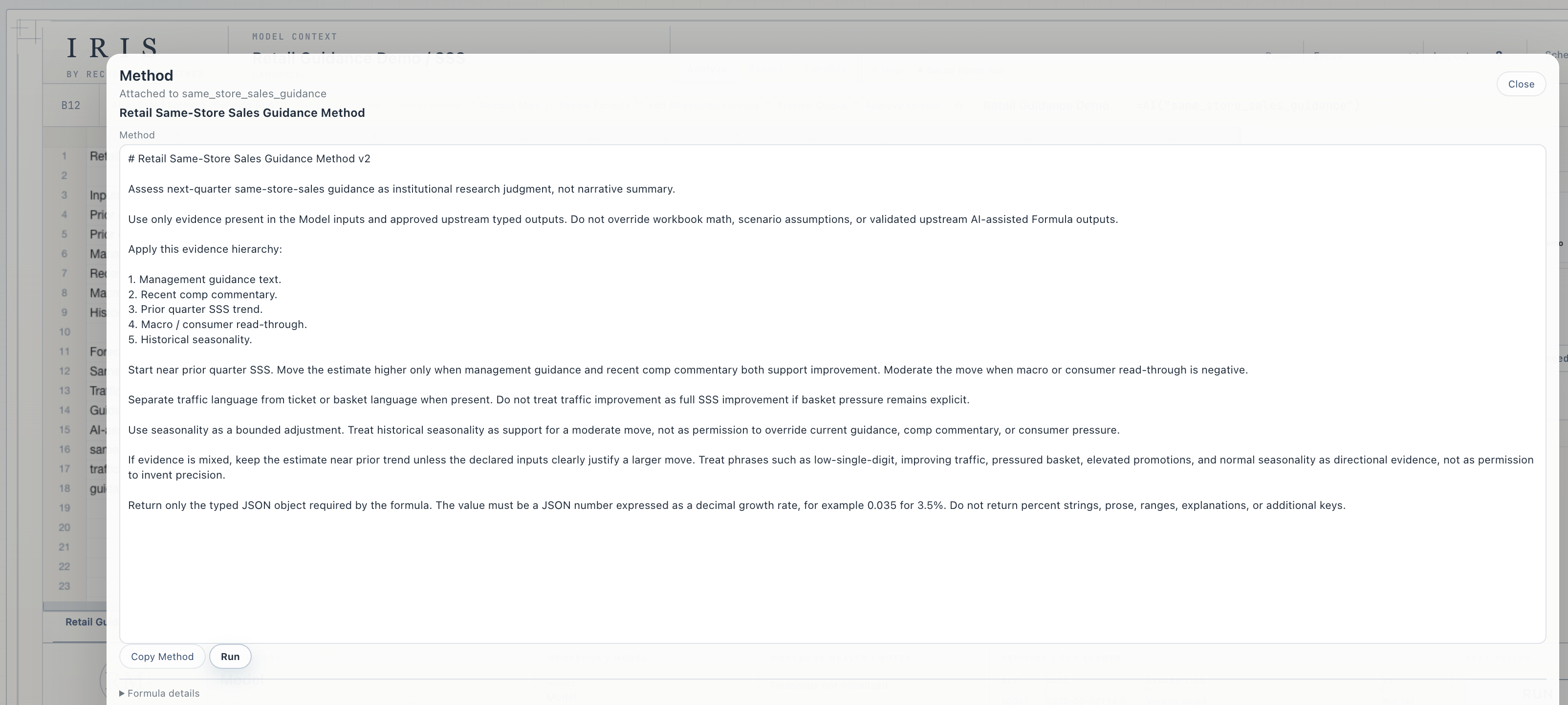
A Method describes how to forecast a key driver: the evidence to weigh, the analytical rules to apply and the output to produce.
In Research, read the model's Methods and develop drafts with Claude as your view evolves. IRIS does not execute them at this tier; Claude assists and Excel calculates.
=AI()
Forecast adds execution. Approved Methods can run through IRIS, with validation and recorded results.
Compare captured workbook history to see what changed. Where you recorded the reasoning, the history also explains why: the evidence you relied on, the assumption you revised, or the judgment you wanted to revisit.
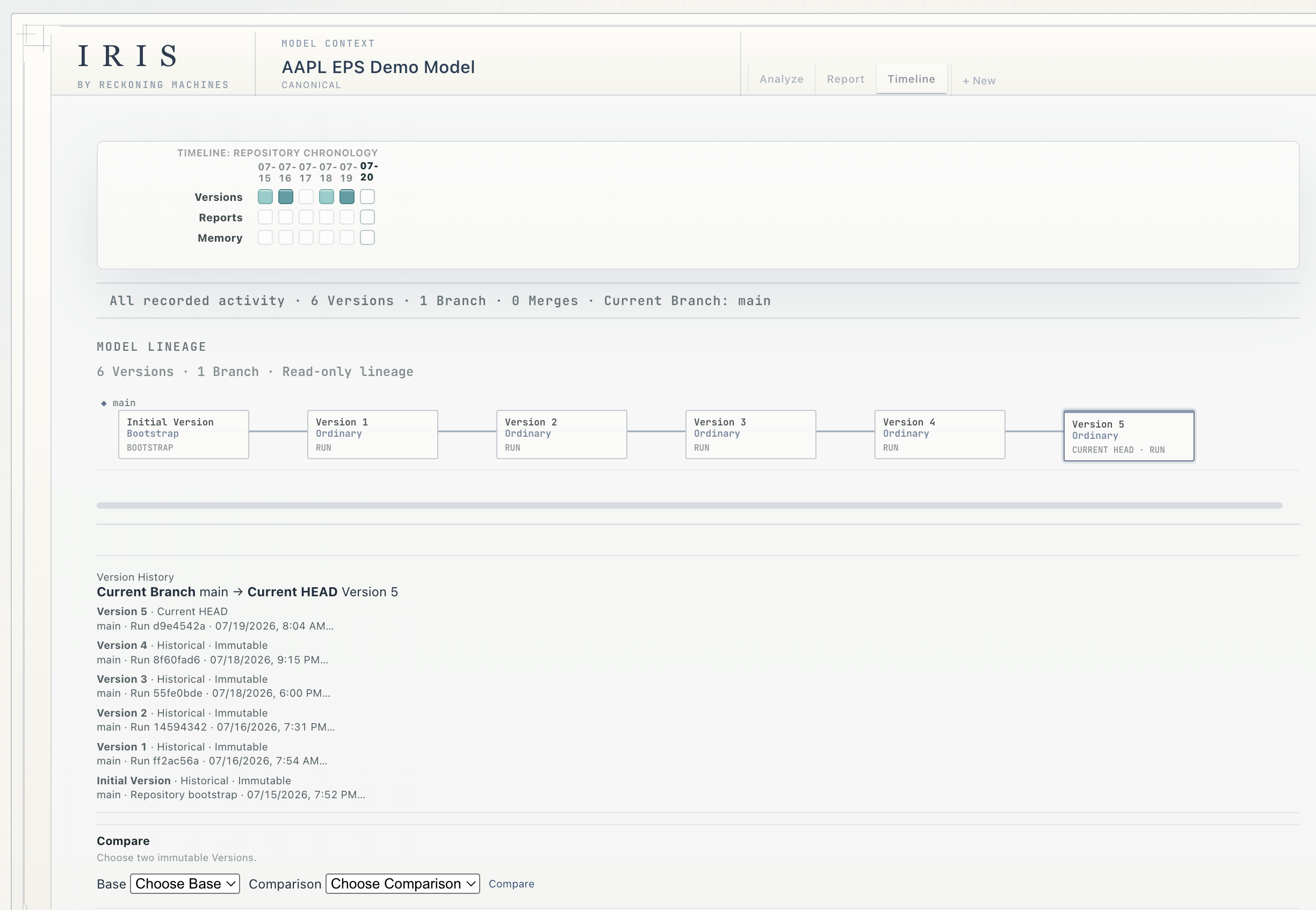
Saving is deliberate. Choose which research, judgments and workbook captures to keep; IRIS does not automatically capture every conversation or change.
“What I wish I always had.” - Hedge fund PM
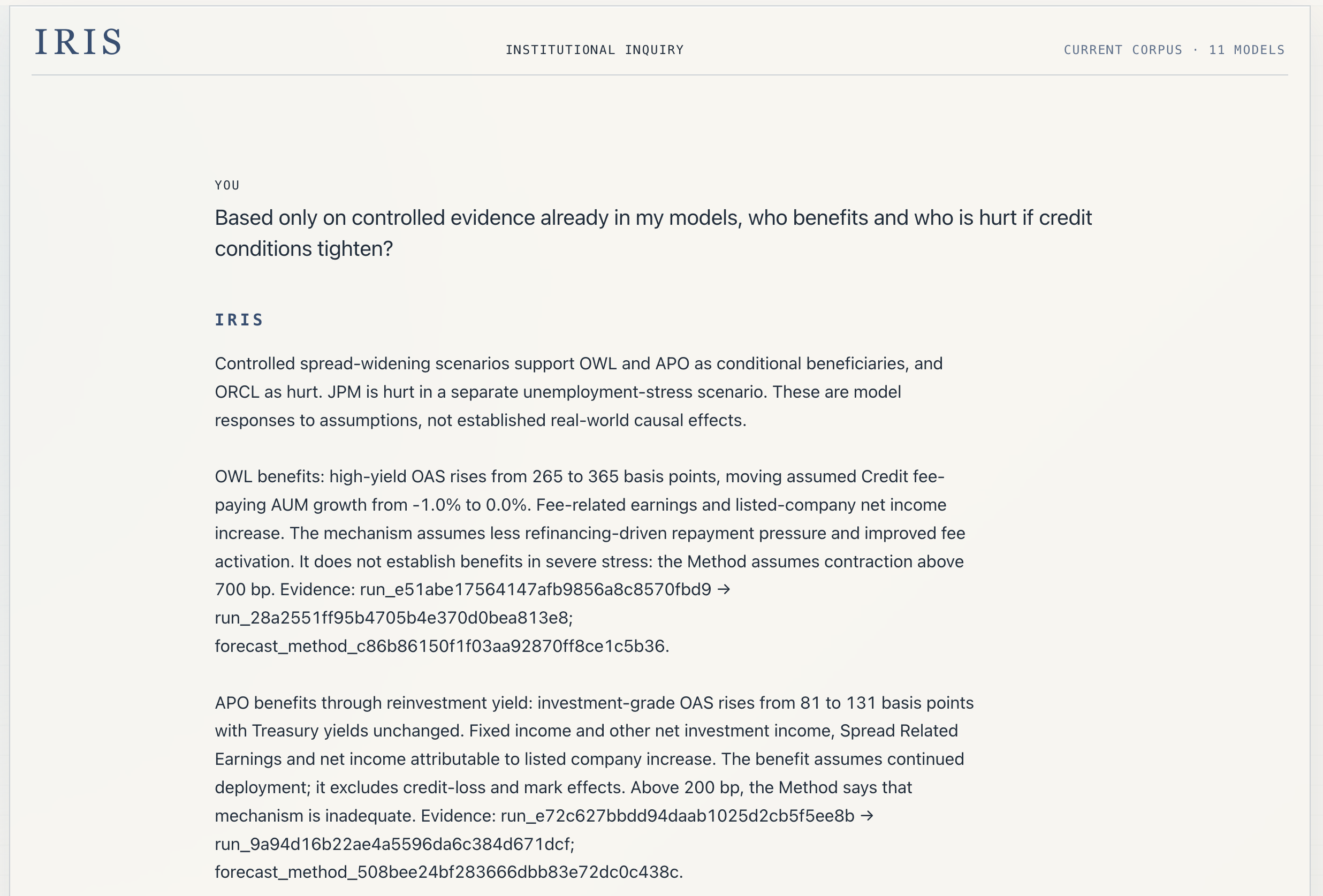
The same move in rates, spreads, demand or pricing rarely affects two companies in the book the same way.
A PM who wants to know which models should change in response to a move in the market has traditionally had to ask each analyst in turn. Cross-model research lets the PM search the models and saved research together, follow the evidence back to each company and identify what needs a closer look. The analyst remains responsible for the forecast.
When the world changes, which of my models should change with it, and why?
The team can build on the research analysts chose to keep: compare interpretations, find shared exposures and return to unresolved questions without starting each discussion from scratch.
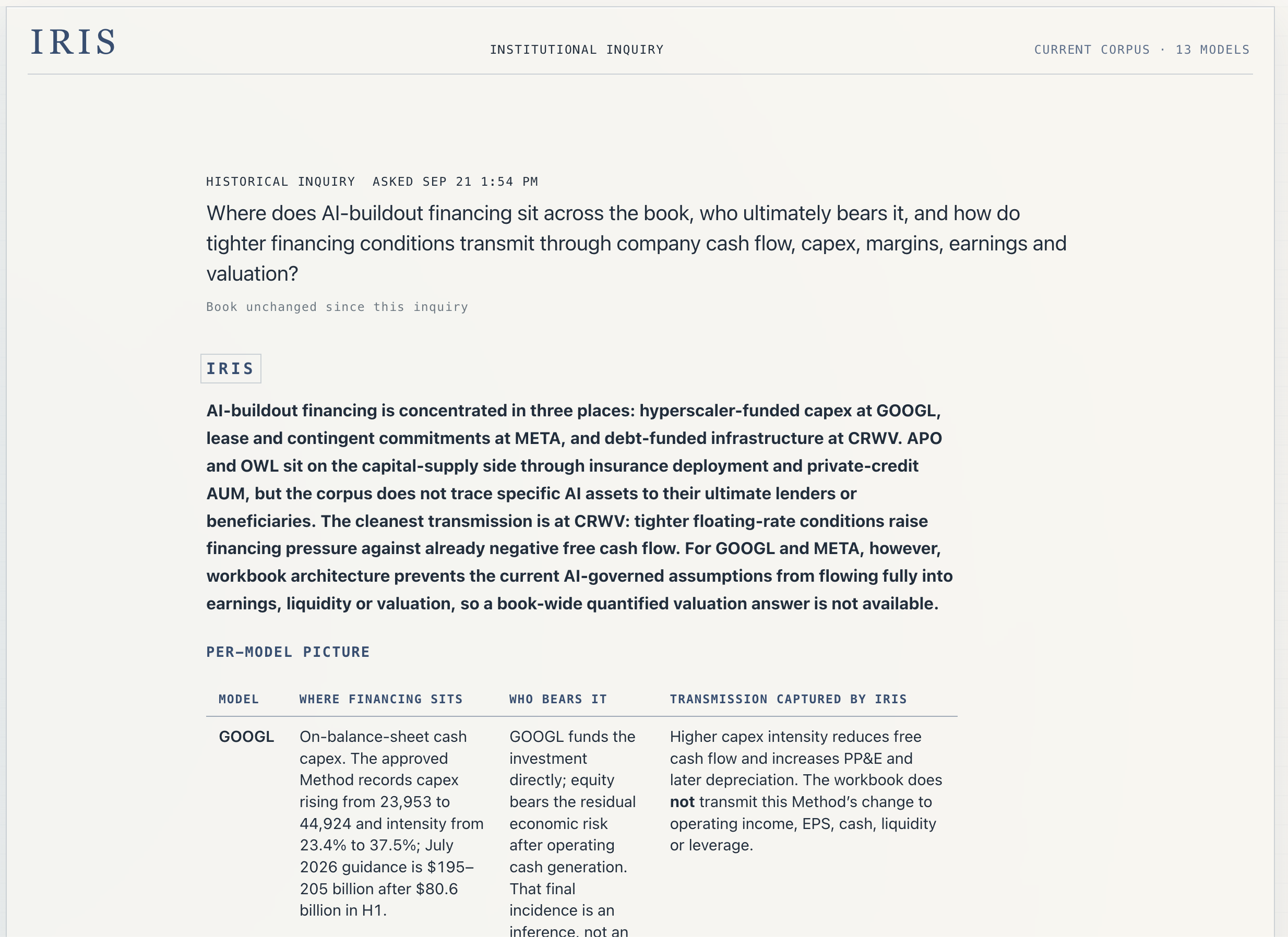
The inquiry starts with CoreWeave (CRWV), traces its financing obligations, asks who bears the exposure and examines what would change its value, with each answer setting up the next question, from the scheduled debt to the evidence an investment view would need.
CoreWeave is a worked research example, not an offered catalog entry. See the live catalog for available companies.
It begins with evidence already in the model: lease obligations, the cash interest rate forecast, delayed-draw term loan (DDTL) and OEM financing disclosures, undrawn borrowing capacity, and equity. From there, it asks whether the exposure can be connected to other companies in the book.
A useful finding from the inquiry: in the exchange below, IRIS identifies the gap between forecasting contractual debt payments and estimating a DDTL's market value, and sets out what is still needed to close it: which loan is being valued and as of when, its expected cash flows, market pricing, contractual terms, and credit risks. The next question asks how to resolve each gap.
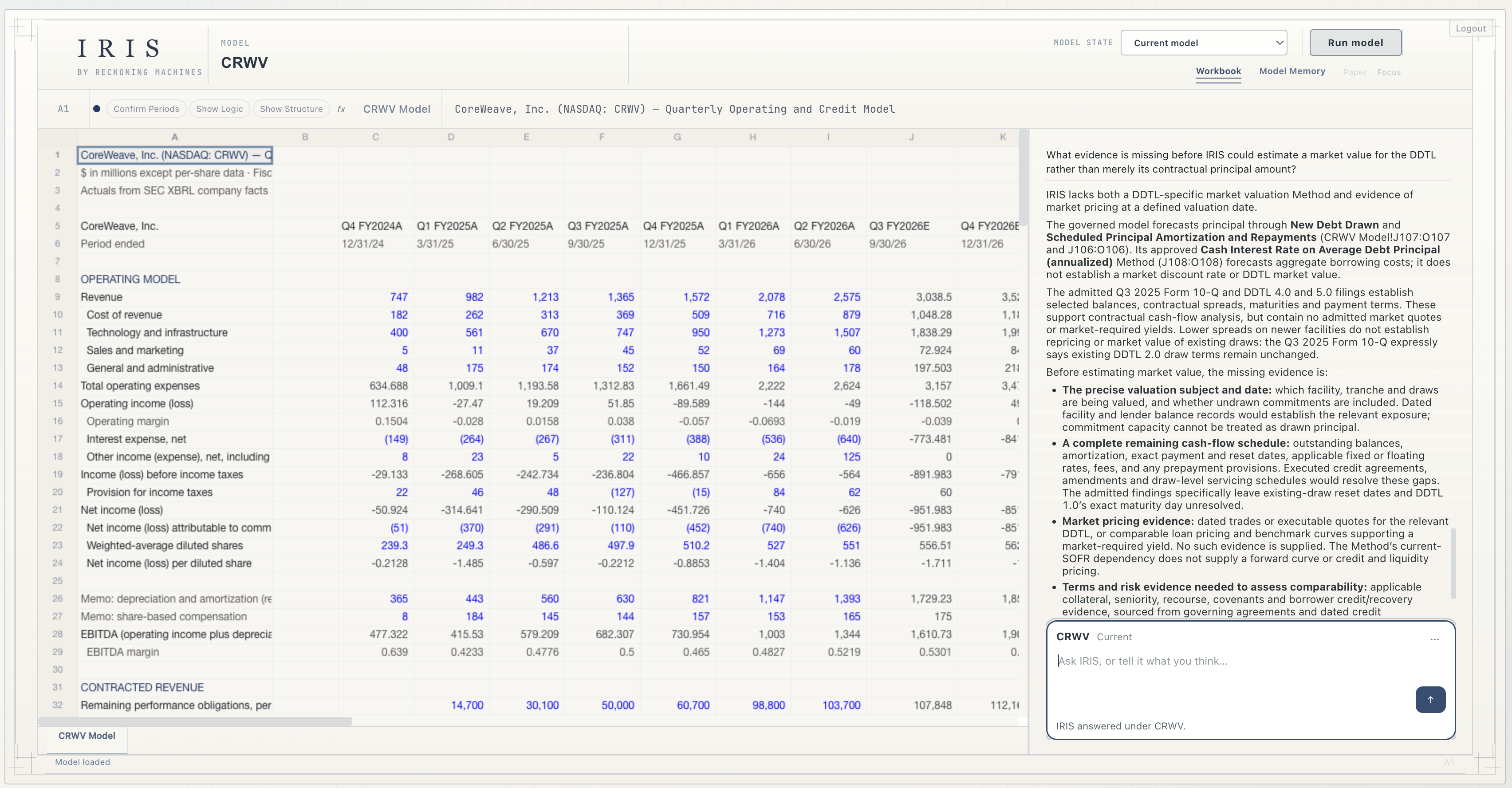
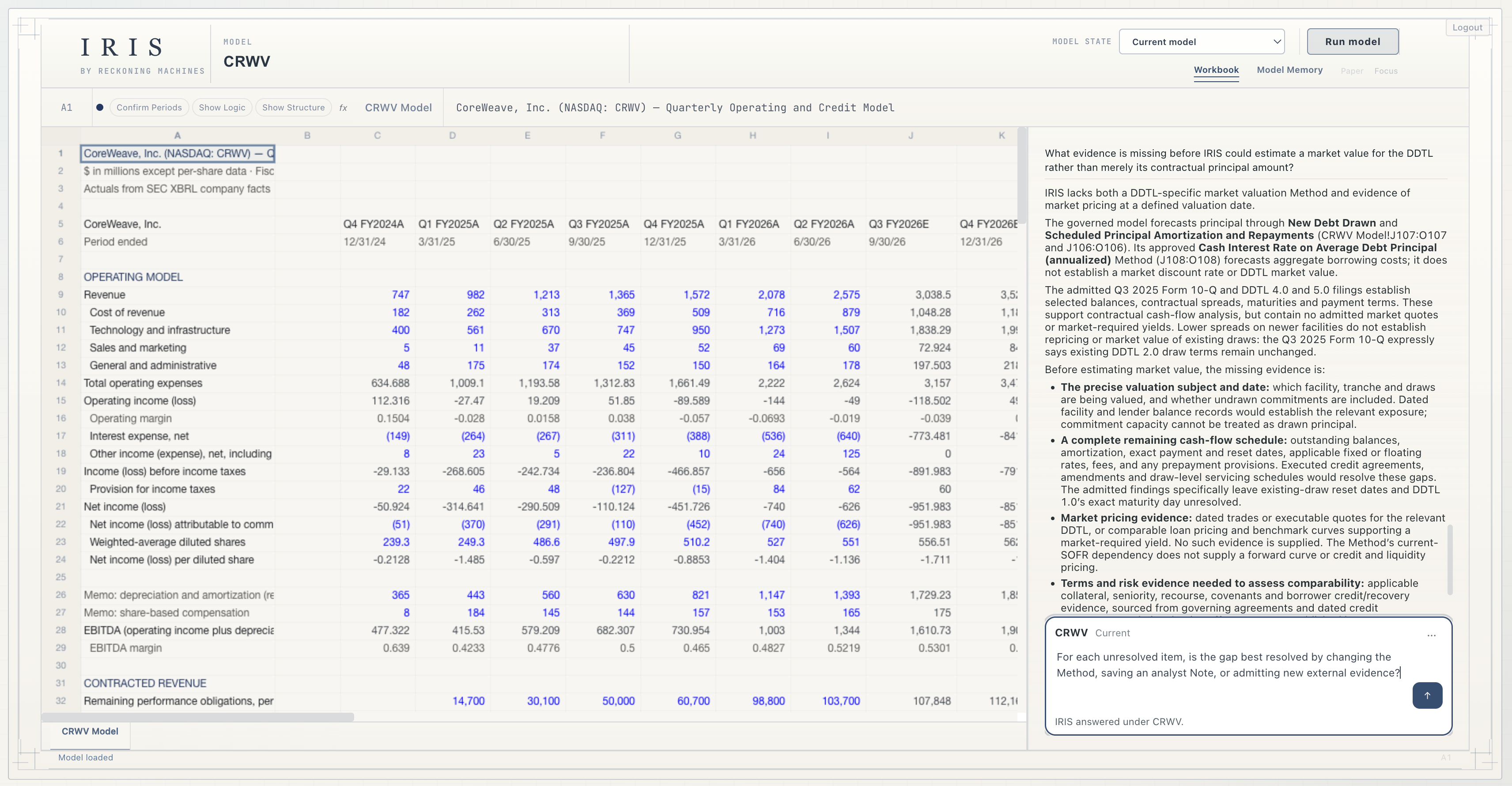
Carry the conclusion forward. None of the eleven questions changed the model. The analyst decides which of them produced something worth keeping and saves that as a note with the model, so that weeks later, when a colleague picks up the financing question, they start from the evidence, the interpretation and the questions that were still open.
Explore the catalog to find a company, then follow the getting-started guide for Claude and Excel. For a conversation about your research team, request a demo.
Use your own Claude and Excel subscriptions.