cc Context Compiler
More reasoning per token.
Our research objective. Competitive measurement is pending.
Request a technical evaluationInvestment research
Which filing governs the bank's reported deposit cost?
In the recorded example it is the quarterly filing. The compiled context carries the filing's figure with the interest expense and average deposit balances it is computed from. Each selected figure links to its source. Ask the same question as of a date before the filing was known, and the compiler refuses and names the two components it cannot find.
Open investing demoWhy a compiler?
A traditional compiler, such as the Unix C compiler cc, transforms source code into a representation a computer can execute. Context Compiler applies a similar idea to information.
It uses declared rules to identify what each claim means and how claims relate across sources. It records those claims and relationships in a structured intermediate representation. From there, it assembles context for a particular question.
- Source evidenceFilings, estimates, research, tables
- Semantic derivationTyped claims, source authority, relationships
- Intermediate representationStructured, traceable meaning
- Task-specific compilationRequired dependencies, Attention, budget
- Model contextEvidence, coverage and source handles
Compression makes information smaller. Compilation makes it usable.
When an investment question requires a financial calculation, cc follows the dependencies to include the necessary inputs. The result is task-specific context with explicit source authority, traceable evidence and reproducible output.
Semantic compression is one benefit. The larger objective is better reasoning with less wasted context.
What it accepts
Typed records, declared tables, and passages that state a measure with its unit. You prepare them, and you declare who issued each source, when it was known, and who may see it.
Context Compiler is a private Python library between your evidence and the model you choose. It applies the authority and dependency rules you declare.
Toward higher Reasoning Yield
At every tested token limit, Context Compiler delivered all required evidence for one more question than Hybrid RAG.
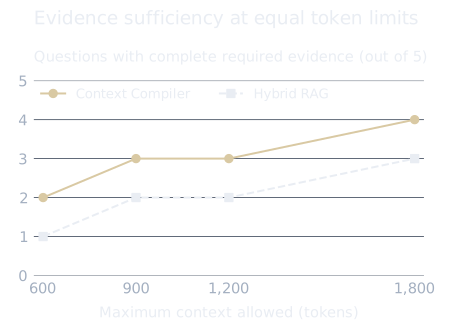
Five answerable questions from one synthetic banking corpus. Both approaches were evaluated under the same context limits. No downstream model answered the questions.
This preliminary test measured only whether each context held the evidence for a supported answer. Hybrid RAG’s filter dropped some filing rows the compiler could still use.
Complete evidence could improve Reasoning Yield, which counts correct, evidence-supported task outcomes per million actual total tokens consumed. Downstream reasoning quality and a frontier shift remain unmeasured.
Claude 2 · Provider-free evaluation · Counts independently reproduced · Chart review pending
Crossover pilot results
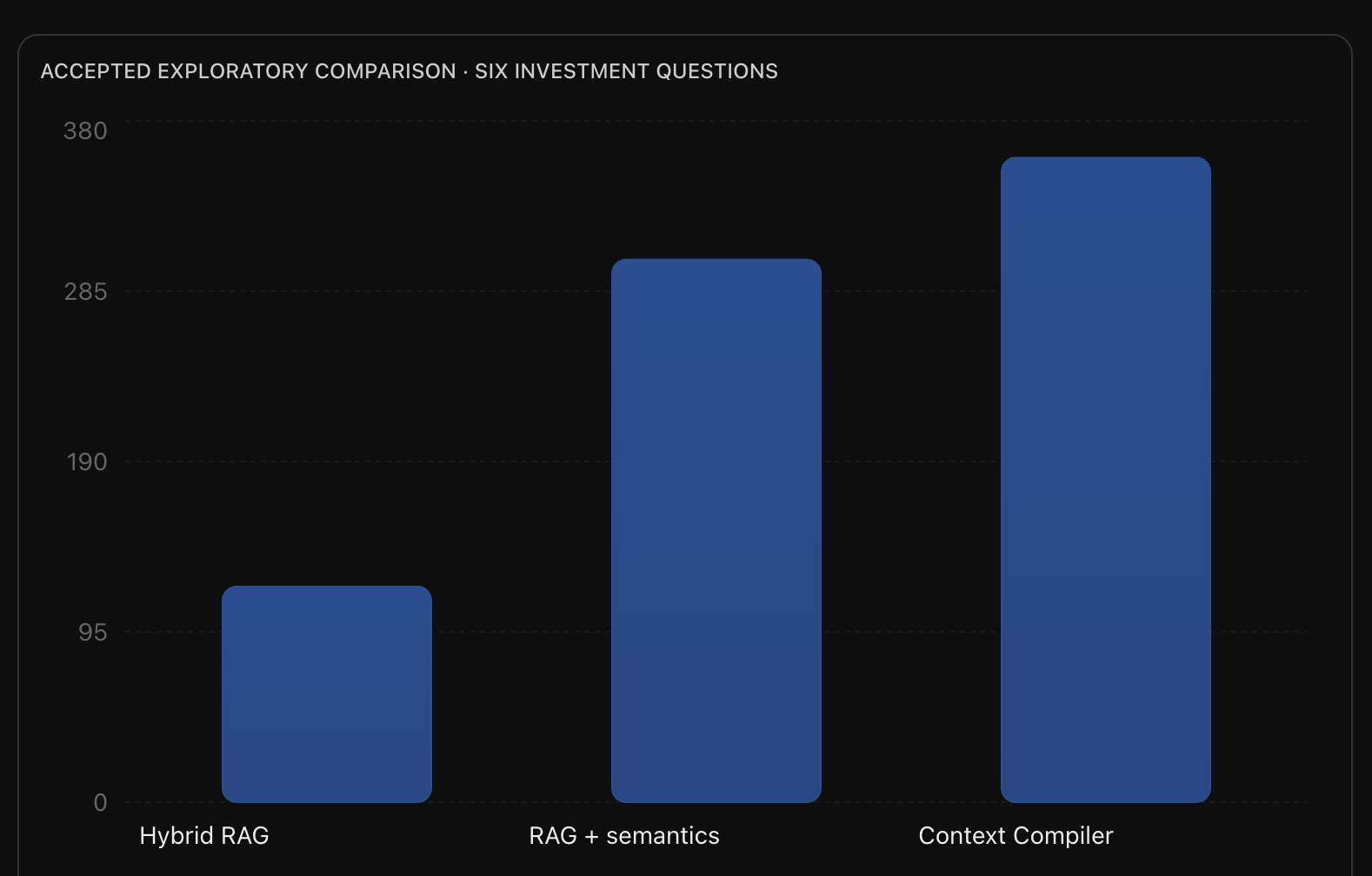
Claude Sonnet 5.5 answered the same six synthetic banking questions, once with each approach. Both had a 1,200-token context limit.
| Measure | Context Compiler | Hybrid RAG |
|---|---|---|
| Correct and fully citation-supported | 4/6 | 2/6 |
| Substantively correct | 4/6 | 4/6 |
| Fully citation-supported | 4/6 | 3/6 |
| Strict JSON compliance | 4/6 | 5/6 |
| Measured input and output tokens | 11,128 | 16,630 |
| Correct, fully supported answers per million tokens | 359.45 | 120.26 |
Independent review reproduced the scores and token totals. Accepting one auxiliary calculation as approximate would raise Hybrid RAG to 3/6 correct and fully supported, or 180.40 per million tokens.
This exploratory result covers one model at one context limit. The competitive frontier remains unmeasured.
Reasoning Yield Frontier
Reasoning Yield counts correct, evidence-supported task outcomes per million total tokens consumed. The frontier is the best supported answer quality attained at each total token budget.
Frontier measurement pending. The planned comparison covers the full compiler, long context, strong hybrid RAG, Graph RAG and enhanced task-aware graph retrieval.
- Give every method the same evidence, domain rules, tasks and downstream model.
- Count total tokens reported by the providers.
- Score evidence-supported answers on held-out tasks.
- Use controlled typed tasks for the primary comparison.
- Report the natural-language comparison separately.
If an existing approach matches or exceeds the compiler's measured tradeoff, the benchmark will show it and we will publish it.
One example
Harbor Regional Bank · March and June 2027 · Recorded state S4
Selected sources
- March quarterly filing, deposit scheduleQuarterly filing · Harbor Regional Bank
- June quarterly filing, deposit scheduleQuarterly filing · Harbor Regional Bank
- Quarter-end target rate observationsOfficial statistic · Federal Reserve
Authority, dependencies, Attention
Filing evidence
| Measure | Period | Value |
|---|---|---|
| Cost of total deposits | 2027-03-31/Q | 2.86 percent |
| Cost of total deposits | 2027-06-30/Q | 3.03 percent |
| Average interest-bearing deposits | 2027-03-31/Q | 6385 USD million |
| Average interest-bearing deposits | 2027-06-30/Q | 6715.000 USD million |
| Average noninterest-bearing deposits | 2027-03-31/Q | 1835 USD million |
| Average noninterest-bearing deposits | 2027-06-30/Q | 1765.000 USD million |
| Interest expense on deposits | 2027-03-31/Q | 58.773 USD million |
| Interest expense on deposits | 2027-06-30/Q | 64.236 USD million |
Trace A1 to its filing cell
March quarterly filing, deposit schedule
table:funding ratios/row:cost of total deposits/col:2027-03-31/Q2.86
What you can check
- S1 refuses when required evidence cannot fit. S2 keeps every required component.
- S4 and S5 use different policies to select optional evidence after the required figures.
- In S5 three estimates conflict. Each keeps its standing and classification. None is chosen.
- S6 and S7 name the missing components and refuse.
- The June filing is known in S4. It is too late for the as-of date in S6.
- Open a figure to see its source, original unit and exact witness text.
Verified privately, shown in an evaluation
- The same inputs give the same bytes in two independent replays of each state.
- The library calls no model and opens no network connection.
- Adding a source outside the reader's access scope leaves the downloadable exhibit unchanged.
- The compiler carries source text as data in its rendering.
The library runs in your environment. Source and packs are provided under agreement. This exhibit uses synthetic data and processes nothing you supply.
Evaluating your evidence
You prepare the evidence, identify its issuers, dates and access permissions, declare which source kinds outrank which, and supply typed tasks and the subjects to cover. Under a confidentiality agreement, we check whether the compiled context is complete, correct and traceable on your evidence. Reasoning quality is a separate measurement.